Questions Importers Can Ask About Evaluating supplier networks in China
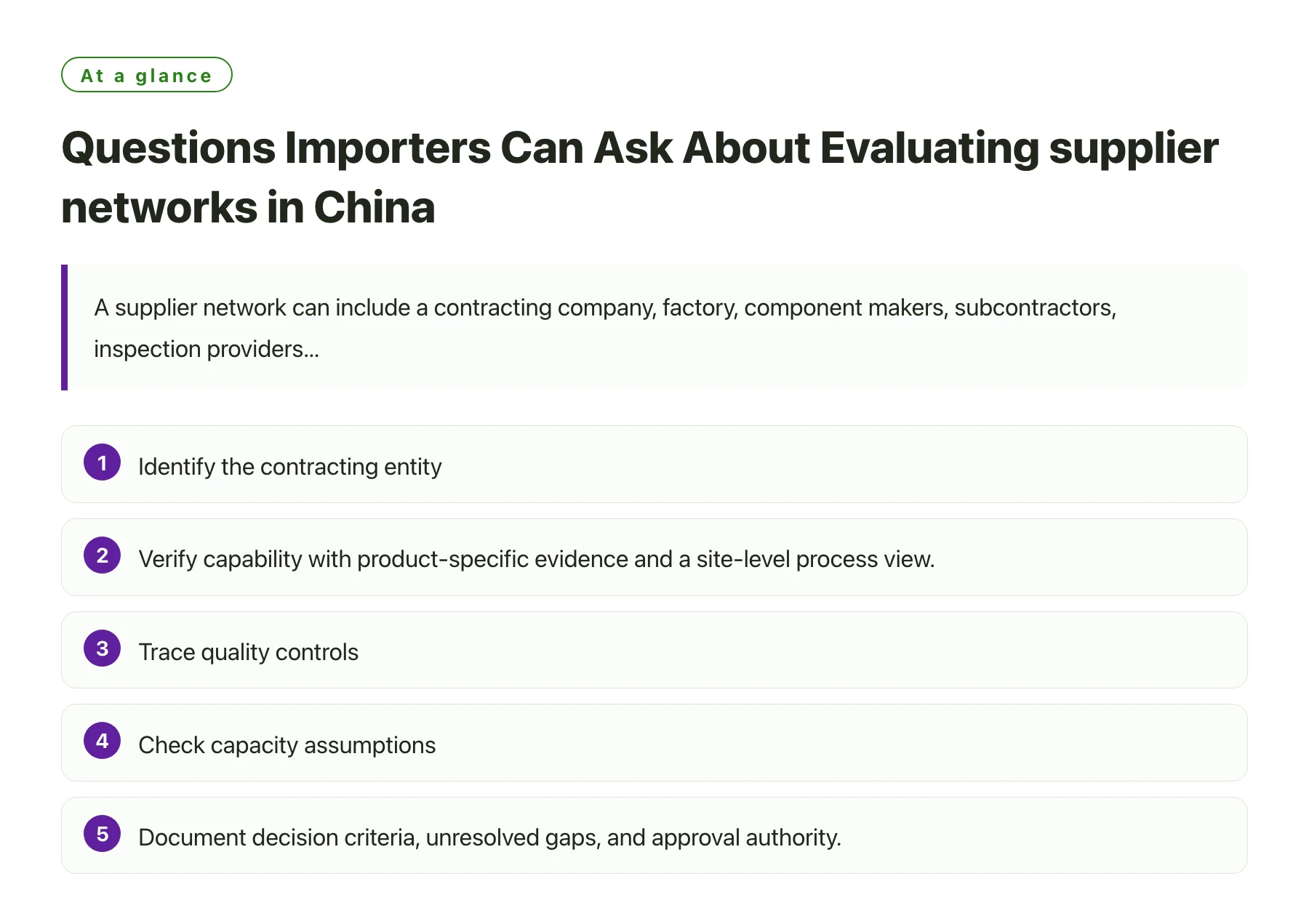
A supplier network can include a contracting company, factory, component makers, subcontractors, inspection providers, and logistics partners. Buyers need to understand who performs each task, who controls changes, and where evidence comes from. Asking structured questions about capability, quality, capacity, and continuity helps reveal dependencies before a purchase order turns them into schedule or compliance risks.
Key takeaways
- Identify the contracting entity, actual factory, and every critical subcontractor.
- Verify capability with product-specific evidence and a site-level process view.
- Trace quality controls, records, changes, and corrective actions to accountable owners.
- Check capacity assumptions, material dependencies, and continuity alternatives.
- Document decision criteria, unresolved gaps, and approval authority.
A useful network review follows the product from specification and materials through manufacturing, inspection, packing, and delivery.
1. Who contracts with the buyer and who makes the product?
Ask for the legal name, registered address, contracting role, payment beneficiary, manufacturing site, and key contacts. Request a process map showing which operations happen at each location. Confirm that the entity named in the quote and agreement matches the intended commercial arrangement.
Distinguish a trading company, sourcing agent, factory, and brand owner by their actual responsibilities. A trading entity may coordinate several capable factories; a factory may outsource critical processes. The important question is whether roles, authority, accountability, and records are transparent and contractually clear.
2. Which products and processes are truly within capability?
Ask for comparable products, production equipment, process steps, tooling ownership, key technical staff, and recent examples of similar work. Review drawings, approved samples, production records, and relevant test evidence. Map evidence to the exact product family, site, and process rather than accepting a generic company profile.
Ask how the factory handles a new design, tolerance, material, or finish outside its routine work. Determine what will require engineering review, new tooling, sample validation, or outside processing. Separate demonstrated capability from planned investment or a supplier’s estimate.
3. How does the quality system work in daily production?
Ask how incoming materials are identified, how operators receive current instructions, which checks happen in process, how final acceptance is documented, and how nonconforming goods are controlled. Request examples with sensitive information removed, then trace one lot from receipt through finished shipment.
ISO 9001 sets requirements for a quality management system; certification, where claimed, should be checked for issuing body, scope, site coverage, and validity. A certificate does not prove every product conforms. Ask how controls apply to the specific product and subcontracted processes. [1]
4. What subcontractors and material sources are involved?
Request a list of critical external processes and materials, including supplier identity, location, scope, approval method, and change-notification rules. Ask which party owns specifications, incoming acceptance, traceability, corrective action, and records when work crosses company boundaries.
Identify processes that could affect safety, performance, delivery, or market documentation. Ask whether the buyer can approve or audit a proposed change. Build contingency options around real qualified sources; a second name on a list is not a usable alternative until tooling, quality, capacity, and lead time are checked.
5. Can the network meet the required capacity and dates?
Request a schedule by process and product, including present loading, available shifts, material lead times, bottlenecks, and committed orders. Compare the requested volume with demonstrated output and prior delivery performance. Understand which assumptions rely on overtime, added equipment, or a future subcontractor.
Ask how peak demand, maintenance, holidays, and staff turnover affect output. Have the supplier identify the earliest warning signals for delay and the person who escalates them. A credible plan includes milestones, capacity evidence, and contingency choices rather than one promised completion date.
6. How are engineering changes and versions controlled?
Ask how drawings, bills of materials, process instructions, labels, and approved samples are versioned. Determine who can authorize a change and how production, inspection, and warehouse teams learn about it. Check whether obsolete material is segregated and how the change affects open orders.
Use a written change request for substitutions to material, component source, site, tooling, process, package, or specification. Require impact review, updated evidence, buyer approval where agreed, and a clear effective date. Traceability prevents a sample from representing one configuration while the shipment contains another.
7. What market and compliance evidence can be verified?
Ask which market requirements apply, who determined the product classification, and which documents support each claim. Match declarations, reports, registrations, or certificates to the exact model, revision, manufacturer, production site, and market. Independently verify key claims with the issuing body or official database where available.
Clarify who maintains technical files, translation, labeling, and post-change updates. Generic certificates or unrelated test reports are weak evidence. Assign unresolved regulatory questions to a qualified reviewer before commercial approval, especially where intended use or market rules change the applicable pathway.
8. How are commercial communication and funds controlled?
Agree on the contracting party, quotation validity, currency, payment milestones, bank-account verification, tooling ownership, warranty, cancellation, and remedy for nonconformity. Confirm that bank detail changes require an independent verification step with known contacts. Keep approval and payment evidence in the order file.
Define which contact can approve specification, commercial, schedule, and quality changes. Establish a meeting cadence and action log for multi-party work. Clear communication paths reduce the risk that a factory acts on informal instructions the buyer never approved.
9. What happens if a factory, component, or route is disrupted?
Ask for continuity plans for power interruption, equipment breakdown, material shortage, labor constraints, transport disruption, and site closure. Identify alternate facilities or sources, qualification lead time, tooling location, data access, and customer approval needed before a transfer.
Assess dependence on one individual, one component source, one port, or one production line. A resilience plan should state triggers, decision owners, and evidence that the alternate can meet requirements. Avoid describing an unqualified backup as ready capacity.
10. How should the buyer make and document a decision?
Use weighted criteria for capability, quality, transparency, capacity, communication, commercial terms, compliance support, and continuity. Screen out mandatory gaps before scoring preferences. Record evidence reviewed, assumptions, open issues, mitigation owner, and review date so a later team can understand the basis for selection.
Buyers assessing JS Sourcing should confirm how supplier roles, factory oversight, quality records, and changes will be managed from quote through delivery. Reassess after major product, site, ownership, process, performance, or market changes rather than treating qualification as permanent.
Sources
Frequently asked questions
Is the company issuing a quote always the manufacturer?
No. Verify the contracting party, actual production site, process owners, and disclosed subcontractors.
Does ISO 9001 certification guarantee product conformity?
No. It concerns the management system; product identity, specifications, testing, and lot evidence still need review.
What is the most useful factory evidence?
Product-specific process records, capacity data, traceability examples, inspection results, and change-control evidence.
When should supplier qualification be refreshed?
Review after changes in site, ownership, process, materials, product scope, performance, or market requirements.