What Makes an Industrial Hose Reliable for Heavy-Duty Use?
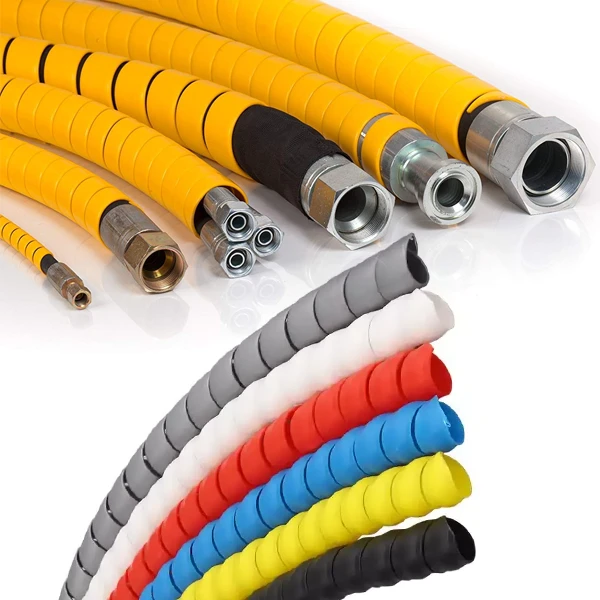
A reliable industrial hose has to keep pressure, temperature, fluid compatibility, bending, abrasion, and fitting retention within rated limits at the same time. SAE 100R2 hydraulic hose, for example, is commonly tested to at least 200,000 pressure-impulse cycles, while SAE 100R12 products can be rated around 500,000 cycles. A 3/4-inch two-wire hose may carry 3,500 psi working pressure while requiring a bend radius near 96.5 mm, yet another hose of the same diameter may have a very different rating. Reliability therefore comes from matching tube compound, reinforcement, cover, fittings, routing, temperature range, and actual machine conditions rather than choosing by hose diameter alone.
Industrial hose construction normally starts with three working parts: an inner tube that contacts the fluid, reinforcement that contains pressure, and an outer cover that takes environmental wear. A Gates 3/4-inch M2T example uses a nitrile tube, two wire braids, a 19.1 mm bore, 28.2 mm outside diameter, 3,500 psi working pressure, and 14,000 psi minimum burst pressure. The 4:1 relationship between listed working and burst pressure gives useful design margin, but burst pressure is a laboratory failure figure, not an operating target.
That distinction becomes more important when pressure is not steady. Pumps, fast-closing valves, cylinders, and mobile equipment can repeatedly move a hose from low pressure to near its rated limit. SAE 100R2 hose products are available with a 200,000-cycle minimum impulse requirement, while SAE 100R12 examples reach 500,000 cycles. A 1983 hose patent describing SAE 100R2 testing recorded 350,000 cycles without failure against a 200,000-cycle requirement, with testing cycling the hose to 133% of rated working pressure.
A hose that survives one high-pressure event is not automatically suitable for a machine that repeats the same pressure rise hundreds of thousands of times.
Pressure endurance depends heavily on reinforcement. One-wire braid, two-wire braid, four-spiral, textile braid, and helical-wire structures do different jobs. A 1/2-inch high-temperature SAE 100R1 hose from Gates uses one wire braid and is rated at 2,000 psi, whereas a 3/4-inch M2T with two wire braids reaches 3,500 psi. Adding reinforcement can increase pressure capacity, but construction also changes weight, outside diameter, stiffness, and bend behavior, so reinforcement count by itself is not a reliable purchasing specification.
Bend radius then becomes part of the pressure problem because steel wire is being asked to hold pressure while changing shape. The same 3/4-inch M2T example lists a 96.5 mm minimum bend radius. Its 1-inch version requires 114.3 mm, while a 1.5-inch version needs 250 mm. Routing a hose below the published radius concentrates strain into a short section and can deform reinforcement near couplings, especially when a machine repeats the movement for thousands of operating cycles.
A useful installation check can be kept simple:
-
Leave enough length for full machine travel without pulling the assembly tight.
-
Keep the first bend away from the fitting whenever the installation permits.
-
Prevent twisting when tightening threaded connections.
-
Check the manufacturer's minimum bend radius for the exact hose size, not only the product family.
-
Inspect both operating positions on moving equipment, since a hose can look acceptable at 0% travel and become over-bent near 100% travel.
Temperature changes the material limits behind all of those figures. Standard hydraulic products are often rated around -40°C to +100°C, but high-temperature constructions can operate substantially above that. Gates lists one SAE 100R1 high-temperature hose for continuous service from -40°C to +135°C, with intermittent exposure up to +149°C. A high-temperature two-wire product is also listed from -40°C to +135°C, while another extreme-heat range reaches +149°C depending on size and construction.
| Operating condition | What should be checked | Why the number matters |
|---|---|---|
| 100°C oil service | Continuous hose temperature rating | A hose rated only to 100°C has no temperature allowance above that published limit |
| 135°C equipment zone | Tube and cover compound | High-temperature nitrile/CSM constructions may be required |
| -40°C startup | Low-temperature flexibility | A hose must bend without cracking during cold equipment movement |
| 3,000 psi line | Working-pressure rating | Burst pressure must not be used as the normal operating figure |
| Repeated actuator movement | Impulse rating and bend radius | 200,000 or 500,000 cycles can separate hose classes |
Temperature also changes chemical behavior. Nitrile is widely used with petroleum-based hydraulic fluids, while EPDM is commonly selected for hot water, steam-related service, and fluids where petroleum resistance is not required. Chemical suitability still has to be checked against the exact fluid because concentration, temperature, additive package, and cleaning chemicals can alter compatibility. A compound that remains stable at 20°C may swell, harden, or lose strength much faster at 80°C or 100°C.
That material check has to cover more than the liquid used during normal production. A plant may run one process fluid for 95% of operating hours but flush a line with solvent, detergent, steam, or disinfectant during the remaining 5%. If the cleaning medium is incompatible with the tube, short repeated exposures can damage the inner surface even though operators never see a problem from outside. Maintenance teams therefore need the complete media list, including flush fluids and maximum cleaning temperature.
Internal wear adds another layer when a hose moves sand, cement, mineral slurry, pellets, powders, or other solids. Particle size, hardness, concentration, velocity, and bend geometry affect how fast the tube loses material. A long straight section may show little damage while a 90-degree routing change receives repeated particle impact in one area. Larger bore size can reduce fluid velocity at the same flow rate, but changing diameter also affects system performance, so abrasion resistance cannot be treated separately from flow requirements.
External wear is easier to see but often develops faster on mobile equipment. A hose rubbing against a steel frame only a few millimeters during every steering or lifting cycle may gradually remove the cover and expose reinforcement. Steel wire exposed to moisture can corrode; exposed textile reinforcement can fray and lose support. Where rerouting cannot provide clearance, hose protection such as abrasion sleeves, spiral guards, or protective wraps can separate the hose cover from repeated mechanical contact.
Protection works best when it prevents contact; it should not be used to make an incorrectly routed hose acceptable.
Fittings deserve the same level of attention because the finished assembly is only as strong as the hose-to-coupling connection. Hose manufacturers normally qualify specific coupling families, crimp diameters, and assembly procedures. Gates, for example, validates several hydraulic hose ranges with named MegaCrimp or GlobalSpiral coupling systems rather than treating every fitting with the correct thread size as interchangeable. A 3,500 psi hose body does not provide a 3,500 psi assembly rating when the coupling, crimp, or adapter is rated lower.
Vacuum service requires another construction check. A hose built mainly for positive internal pressure may flatten when suction creates negative pressure. One SAE 100R4 return-and-suction example uses textile reinforcement plus helical wire, carries a 350 psi working-pressure rating, and is listed for 25 inHg vacuum. Its 3/4-inch size has a 63.5 mm minimum bend radius and a 1,400 psi minimum burst pressure. The helical element helps the hose keep its shape while the internal pressure falls below atmospheric pressure.
Dimensions can also mislead buyers because equal inside diameters do not produce equal performance. Published 3/4-inch hydraulic hoses can range from roughly 1,250 psi to 3,500 psi depending on construction and temperature class. A 3/4-inch SAE 100R1 high-temperature hose is listed at 1,250 psi with a 120 mm bend radius, while the two-wire M2T example reaches 3,500 psi with a 96.5 mm radius. Both carry a 19.1 mm nominal bore, yet their pressure ratings differ by 180%.
For purchasing, the specification sheet should therefore contain actual operating numbers rather than labels such as “heavy-duty” or “high pressure”:
-
Hose ID and required flow rate
-
Normal pressure plus expected pressure peaks
-
Continuous and intermittent temperatures
-
Exact fluid, concentration, and cleaning media
-
Required vacuum level, if any
-
Minimum bend radius and movement range
-
Expected abrasion location
-
Coupling type and assembly method
-
Required impulse performance, such as 200,000 or 500,000 cycles
-
Applicable SAE, ISO, EN, MSHA, marine, or equipment requirements
Inspection intervals should then reflect service severity instead of relying on a single calendar rule. A stationary hose operating at 30% of rated pressure in a clean indoor area does not experience the same wear as a loader hose operating near rated pressure, bending every work cycle, and rubbing against dirt or steel. Inspections should look for cover cracking, cuts, blisters, hardening, flattened areas, exposed reinforcement, fitting movement, leakage, corrosion, and bends below the specified radius.
Replacement records make those inspections more useful. Recording installation date, machine hours, failure position, fluid temperature, pressure setting, and observed damage allows maintenance teams to compare multiple assemblies instead of treating each failure separately. If 8 of 10 removed hoses show abrasion at the same frame contact point, routing needs attention; if assemblies repeatedly fail close to a fitting after similar service hours, bend geometry, crimp dimensions, vibration, and coupling selection deserve review before another hose is installed.